
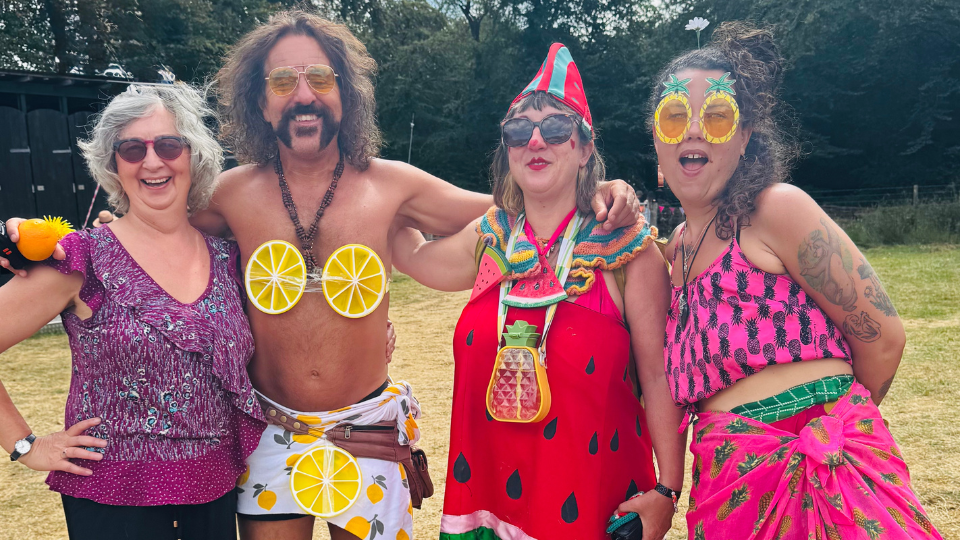
When it comes to embracing festivals, I’m a laggard – a definite case of “better late than never”.
To be fair, my first experience of festivals was back in the 70s – when they were hardcore and distinctly lacking in creature comforts. At age 14, my 20 year old sister – ultra cool in my eyes as she was at Uni having a whale of a time while I was still at convent school choosing my O-Level options – let me tag along with her mates to see The Rolling Stones at Knebworth. A rock festival retrospectively dubbed “the UK’s Woodstock”, over a quarter of a million people turned up to the grounds of a stately home in Hertfordshire to see the Stones, supported by quirky 70s band 10cc and Deep South rockers Lynyrd Skynyrd.
Facilities were rudimentary and I have an enduring memory of guys giving up on the woefully inadequate portaloos and peeing en masse against the corrugated fencing, the perimeter of the site turning into a rancid lake of piss. We were young and resilient and shrugged off this squalor, but it must have subliminally left its mark, as in adulthood I went to gigs but avoided big festivals fearing I’d feel overwhelmed by the crowds.
Recently I decided to try out a smaller, gentler gathering, where music happened in tents dotted around the site and I didn’t have to jostle for a space in the mosh pit down the front.
So the other week I found myself at “Buddhafield” – a 5 day drug and alcohol free festival in Somerset. I’ve known about this festival for years and friends have enthused about it, yet something about the meditation-flavoured name and the restrictions (even though I rarely drink and my drug taking is limited to the occasional psychedelic retreat) gave me the impression it might be worthy and virtuous – too much transcending my desires rather than pursuing them.
How wrong I was.
I spent the first day exploring this magical world – an exquistive mix of of the things I most love to do: dance, music, singing, theatre and performance, workshops, talks by activists, yoga, rustic saunas and yes, even some meditation spaces. Added to this was the joy of just strolling around, watching people express themselves freely. I registered a slight jolt when, washing my face after breakfast at the sink by the composting loo I encountered a bare breasted woman, chatting away to me as if it was the most normal thing in the world. Coming from “Muggle” world where there is so much body shaming, it took me a few hours to recalibrate to this new environment.
Music performances were low-key, accessible and mosh pit free – sitting together cosily on the floor of a marquee to watch indie-folk singer Martha Tilston – voice like an angel, clever lyrics and her small yet devoted fan base creating a sense of buzz and excitement.
Over the five days I ran into more than a couple of dozen people I’ve met over the past three decades at workshops, personal development groups and holistic holidays. Some recognised me, some didn’t (to be fair I’ve gone grey since the pandemic). It was like a past life review, starting with the running into the delightful Ian, who I met on holiday at Skyros, Greece almost 30 years ago to the day.
Plus, I LOVE camping (the fair-weather kind obvs) and how it forces me to slow down. Camping is resolutely analogue: to make a cup of tea I have to fetch the water, light the stove and boil the kettle, rummage in the food bag for teabags and milk, locate my sloppily rinsed camping mug. On the dopamine seesaw of pain/pleasure, the effort I put in means the eventual brew is all the more satisfying, a sense of achievement that I just don’t get from flicking a switch in my kitchen on autopilot whilst listening to a podcast.
I luxuriate in sitting around a campfire nattering with others – time feels spacious and expansive, I become more caring and generous towards others – instinctively making cuppas for everyone and enthusiastically proffering my mallet to whoever needs it. I like the person I become when camping – a kinder, more generous version of me than the sharp-elbowed commuter homing in on the last seat in the tube carriage and woe betide anyone who gets in my way. The culture we are in shapes our behaviour, and a well designed festival creates a sense of community and invites our better selves.
And kudos to Buddhafield for its ethics: solar powered, composting loos, recycling but no landfill (take your rubbish home with you), vegan food, kind and helpful stewards and an outstanding programme – so well thought through.
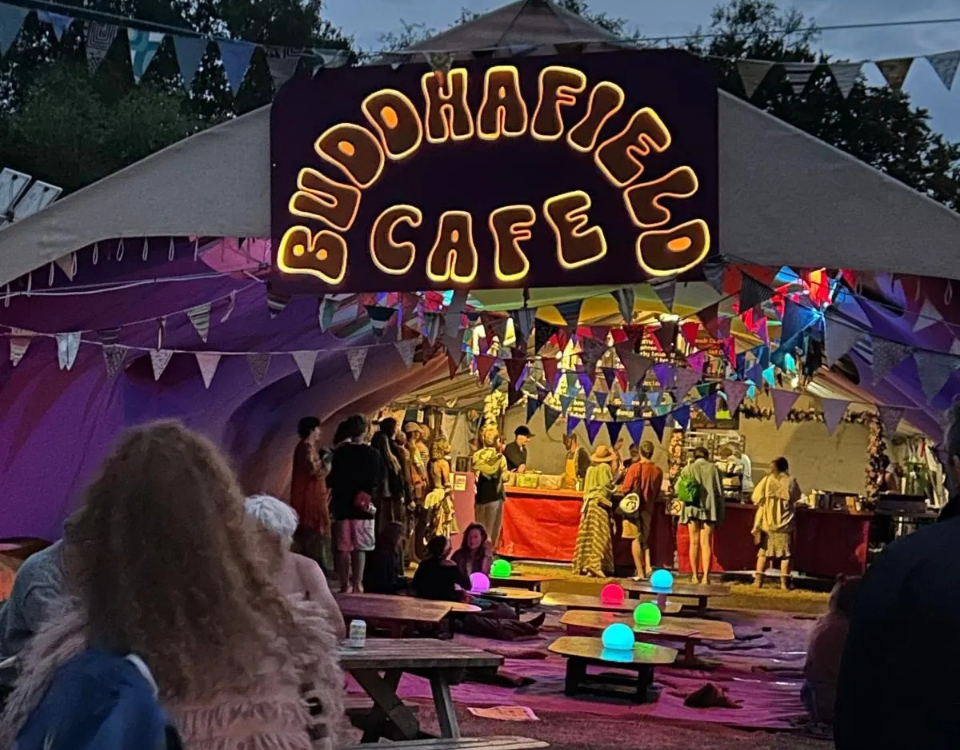
Festivals create a mini world where for a few precious days we can imagine we’re living in a delightful village with our “tribe”, able to sample a smorgasbord of delectable offerings, right on our doorstep, all in one place. I think we love festivals because they give us a brief moment of seeing how life could and should be. Not far below the surface of our cellular memory is the memory of a time when we lived in small communities and were known by others, where a sense of belonging and shared purpose gave us a profound sense of security.
The cynical part of me would say that festivals represent the honeymoon period of a relationship where we fall in love with each other and everything is rosy, so just dipping into a festival and imagining a fantasy community where we all live in harmony is dangerously unrealistic. Yet, I think even giving ourselves a glimmer of a different way of living is a healthy counterbalance to our increasingly isolated world where our primary relationship is with our iPhones.
We’re rapidly losing “third spaces” where people can gather in person on a regular basis, and as social animals we weren’t mean to spend most of our days physically alone, relating to others primarily through a screen. We need physical touch, smell and to see others in the flesh.
Part of why the recent World Cup was so joyous was watching the fans gather together, wear their team colours and sing and dance en masse: the Norwegians with their Viking rowing, the Dutch with their “hop to the left/right” routine – those moments where self consciousness and isolation are swept away by a collective sense of purpose and belonging. Festivals harness this energy too.
Festivals have become a huge phenomenon in Britain in recent decades, speaking to a deep hunger in us for these experiences. When so much in the world seems to be heading in the wrong direction, I take heart from the popularity of festivals – from the mega Glastonburys to the intimate Buddhafields – they remind me that, given the right conditions to flourish, people are basically good.
So, if you’re leading a team or a project – what small steps can you take to make your team less Factory and more Festival?